
By: Anna Eppe March 15, 2026
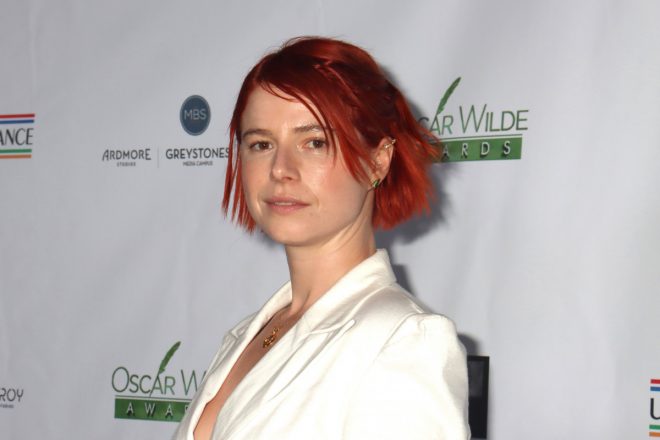
Jessie Buckley is a real bride who knows how to stand out. She really knows how to tap into her character despite how crazy of a journey this “love story” just might have been.
Text and Edit by Anna Eppe / Hollywood News Wire Inc.
Interview by Izumi Hasegawa / Hollywood News Wire Inc.
Q: What was important to you in giving her a voice finally?
Jessie Buckley: Well, I think firstly, what a great opportunity to like, give voice to something that wasn’t permitted or had that opportunity before. Even in the 1935 version of Elsa Lancaster, it has such an impact. That’s just the precipice that we’re bouncing off of. And to know that character in our side view and to feel the potential of what that character might have said, that really was so exciting and there was a whole landscape of things that we could have said, but I feel like together with both of us (Maggie Gyllenhaal), what we were really trying to say was, the stuff we maybe don’t know how to say, or the shadowy bits. The bits that we don’t actually, you know…she doesn’t get reinvigorated with a definite idea of herself. She gets reinvigorated with huge questions, but something that’s deeply embodied. She’s got a mind and body that is reinvigorated in a way that she doesn’t even expect herself. Like it’s so alive, it’s so monstrous in the most kind of wild, brilliant, like a laser beam kind of way. And she’s questioning, you know, she’s questioning out survival in order to discover herself. And I think what was essential to both of us was that this woman’s mind and body were in deep conversation with the reality that she’s woken up with this man who she’s definitely curious about. She’s not screaming and saying no. She’s like, where am I? What is this? What is love? What is marriage? And what have I got to say towards this world that I believe can, like, I think this world can hold all of me. Not just a slice of me, but all of me.
Q: After the haunting stillness of Hamnet, how did stepping into The Bride! feel like breaking the glass on something wilder?
JB: Well, it was actually the reverse. I filmed The Bride! before I filmed Hamnet, and I had two weeks between finishing The Bride! stepping into Hamnet. And I actually think they were intrinsically essential to both of those films, but especially The Bride! I think what I discovered in myself was the woman that you discover at the beginning of Hamnet is the woman that I birthed in myself in Bride (Jassie’s character). You know, a woman who has a language of her own, is deeply embodied, is ready to love wildly and on their own terms, like really love, you know, not like, I think in some ways when Agnes (Jessie’s character in Hamnet) is able to let Will go, it’s because she has a substantial love. And I think the love that I experienced and explored in The Bride! was like my heart was cracked wide open. Yes, I came into fittings with bleached eyebrows and like an electrical current pulsing through me. And over the two weeks I had to kind of distill all that really incredible energy right down and put my hands in the ground. But like, what a gift, you know, what a gift to know both of these women inside me, and I’m never gonna let them go.
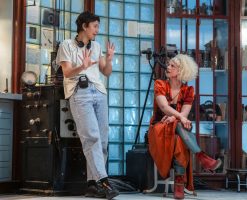
Q: How did your previous work for Maggie Gyllenhaal (Director of The Bride!) influence the way you approached this project? What was your partnership (with Maggie Gyllenhaal) to collaborate to bring The Bride to life?
JB: Well, I think this kind of relationship is so rare and so precious, and I think when we both met on Lost Daughter, there was a meeting of minds and souls and really we were speaking a language together, and I can’t really describe what that is, but you know, sometimes it’s just somebody looking into your eyes and saying, “I see you and I dare you to go to the place that maybe you don’t know yet, but I know I can guide you.” And I think for both of us, we both can do that for each other. And you know, The Lost Daughter was just the beginning of it. And to come back and go even deeper together, to go even more wildly into our imagination possibility as two women to see each other and actually stretch our limbs in a sandpit while feeling the strength of each other’s minds and hearts. I mean, I know and hope this is just the beginning of a long love affair with each other. And she’s my Scorsese (reference Martin Scorsese, the famous film director). We also were like dreaming that this black mark is almost like the ink that Mary Shelley wrote Frankenstein from, you know, and because she’s embodied by both Mary Shelley, who is underground, who was living in an underworld for a hundred years, not also not being able to say the things that she wants to say that when she is reinvigorated it comes pouring out of her. Like it’s pouring down her arms, it’s creating a mark on this woman. Like create an expression on this woman that, yeah, both of these women are kind of in a fusion with each other.
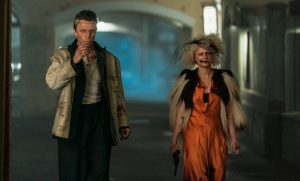
Q: Were there any questions that you wanted to answer about this character?
JB: Firstly, don’t we all have a Mary Shelley in our head in some shape or form that’s like egging us on to do the thing that maybe we might be scared to do or like our potential. And I think what I really loved about what Mary Shelley was kind of demanding of herself, questioning of herself, putting herself on a precipice of falling off the cliff was about love, really. You know, in her original story, she creates this incredible creature born out of the parts of humanity that are broken and she sows them together. And then she’s faced with this creation and it’s almost so frightening that in her novel, she locks him up. And what makes this monster monstrous is loneliness. You know, all he’s asking for is love and she will not give it to him. And I loved that actually a hundred years later underneath the like, I mean, I imagine her under like, neat, she lives in middle earth underneath a volcano with all this ash around her, and nobody has heard her until this moment where actually there’s a chink of light coming through. And she’s like, I need to give it love. I need love. I wasn’t brave enough. I was too scared to love the last time. But what if the scare, what if I do give this person love and not an idea of love, not like The Bride of Frankenstein or even the idea that Frankenstein is reinvigorated is like he has, I mean, our story, he’s also going on a journey of self-discovery. He was given an identity in Frankenstein, he was told he was a monster. And actually through this demanding, commanding relationship with the Bride, they’re really discovering how to be in relationship with each other. And not just the idea of marriage or the idea of love, but like how do we command real deep, dangerous love where all of who we are can be seen, and especially the monstrous. Until she gets to the end and actually has metabolized her identity. She’s dissolved the archetype of the Bride of, and has become her own name, has found her own autonomy, has called herself. And Mary Shelley is like, “That’s my girl.” I couldn’t even come up with that.
The Bride! Now out in theaters.
