
By: Izumi Hasegawa July 31, 2026
The new film by Hirokazu Kore-eda, one of Japan’s leading directors, is a story about a couple who have lost a child and attempt to recover from that loss through their interactions with a humanoid. In an age when AI is a daily topic of conversation, what did Kore-eda set out to convey with this work?
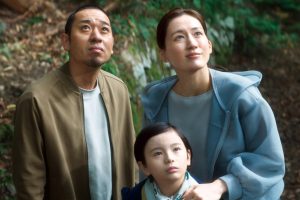
Q: This film seems to go a step beyond the current debate of “Can AI replace humans?” What did you want to convey with this work?
Kore-eda: Perhaps the question “Who does the deceased belong to?”… I almost never start a film by deciding in advance what I want to convey, but if I had to put it in terms of “let’s think about this through the film,” it would be posing the question “Who does the deceased belong to?” in various forms through the story of one married couple. My debut film (Maborosi) was about grief work. Ever since my twenties, I’ve been interested in how people’s emotions shift and how they behave during the process of recovering from loss, and I think that’s why I’ve made several films on that theme in different forms.
Q: This time you not only wrote the screenplay and directed, but also edited the film. Normally when a director also edits, the tendency is for redundant parts to stand out and hurt the pacing, but that never happens in your films.
Kore-eda: After writing the script, the director has to critique that script, and then the editor has to critique the direction. If those relationships don’t exist, the film becomes flat. I completely forget any “I worked so hard on this scene, I want to keep it” feelings and cut while thinking, “This guy is no good. This isn’t working.” It’s like there are three of me: the screenwriter me, the director me, and the editor me. [laughs]

Q: Your films often give the impression of dealing with the darker sides of society or socially vulnerable people. Is there a guiding principle behind your choice of themes and projects?
Kore-eda: It’s less about “I’m going to expose the dark side of society” and more something that struck me when Kate Blanchett said at the Cannes Film Festival that I “shine a light on invisible people—people who are unseen or regarded as nonexistent.” That made sense to me. But it’s not that I go through life deliberately searching for such people. Rather, something casually catches my attention and, unexpectedly, stays with me. There are a few things that make me wonder, “I wonder what happened with that,” so I start following them or expanding outward from them, and those become seeds. This time, when I saw a news story about a business in China that uses generative AI to recreate the dead and how popular it had become, I thought of how they revived Misora Hibari in Japan. When I looked into it a little more, I found similar efforts in South Korea that had drawn heavy criticism—cases of a mother “resurrecting” her deceased child, for example. As the idea spread that way, a vague unease inside me gradually took shape. Plenty of those feelings just fade away or get forgotten, but this time it turned into this film.
His next film is an adaptation of the manga Look Back, which will be released in Japan in September. That work also deals with loss, so Kore-eda’s exploration of grief work appears to continue.
English translation by Jerry Jorgenson / Hollywood News Wire
